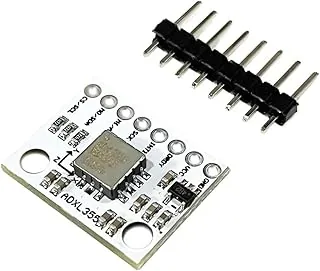
SENS-ADXL355
Accéléromètre ADXL355 (industrial grade)
ADXL355 low-noise ±8g — grade industriel pour CBM machine tournante.
Technical analysis
On a rotating machine, the signature of an incipient bearing fault appears as lines of a few tens of milli-g, buried in noise. What decides detectability is the sensor's noise floor: at 22,5 µg/√Hz (±2 g), the ADXL355 sits an order of magnitude lower than a general-purpose accelerometer such as the MPU6050 (~400 µg/√Hz). Its 20-bit output and bandwidth up to 1 kHz cover the classic fault frequencies (BPFO/BPFI, gear meshing) with enough dynamic range for FFT. Its response down to DC also allows tracking of tilt or slow imbalance.
Honest limits: the usable band tops out at 1 kHz — insufficient for very-high-frequency gear defects or cavitation ultrasound, where an IEPE piezo (10–20 kHz) remains superior. The ±8 g range confines its use to vibration, not violent shocks. For cheap, coarse screening, the ADXL345 or the MPU6050 are enough; the ADXL355 is justified when the goal is reliable spectral analysis, not a simple threshold alarm.
Verified specifications
Every figure below is sourced from the manufacturer datasheet.
- Ranges (selectable)
- ±2,048 / ±4,096 / ±8,192 g
- Noise density (±2 g)
- 22,5 µg/√Hz typ.
- Output resolution
- 20 bits
- Bandwidth (low-pass filter)
- 1 Hz to 1 kHz programmable
- Interfaces
- SPI and I²C
- Operating temperature
- −40 °C to +125 °C
References & standards
📄 Official manufacturer datasheet — Analog Devices
Applicable standards
- ISO 13373 — Condition monitoring by vibration analysis — the ADXL355's noise floor and DC response place it in the precision-CBM register.
- ISO 20816 — Machine vibration severity (zones in mm/s RMS): the sensor measures in g, velocity is obtained by integration.