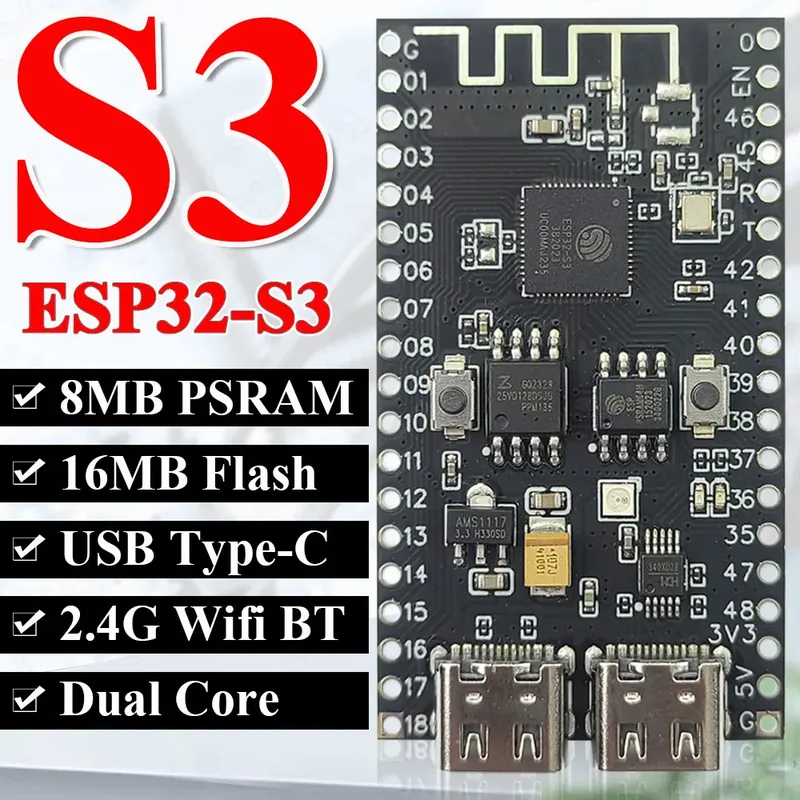
MCU-ESP32-S3-N16R8
ESP32-S3 N16R8 (16MB flash, 8MB PSRAM)
ESP32-S3 optimisé edge AI — accélérateur vectoriel, 8MB PSRAM, USB OTG.
Technical analysis
The ESP32-S3 adds to the WROOM what matters for intelligent edge: vector instructions that accelerate neural networks and signal processing, plus 8 MB of PSRAM (N16R8 config) to handle substantial buffers — spectra, audio windows, small images. It is the TinyML board: vibration or acoustic anomaly detection right at the foot of the machine, without a cloud round-trip.
It remains a microcontroller: no Linux OS, no heavy Python framework, a memory footprint to manage down to the KB. For a model that does not fit these constraints, or for real-time vision, you need the Raspberry Pi 5 (general-purpose) or the Jetson Orin Nano (CUDA). The S3 excels when the model is small, latency is critical and consumption is counted.
Verified specifications
Every figure below is sourced from the manufacturer datasheet.
- CPU
- Xtensa LX7 dual-core, up to 240 MHz
- AI/DSP acceleration
- vector instructions (neural networks, signal processing)
- Wireless
- Wi-Fi 802.11 b/g/n + Bluetooth 5 (LE)
- Internal SRAM
- 512 KB
- Module memory (N16R8)
- 16 MB flash + 8 MB PSRAM
References & standards
📄 Official manufacturer datasheet — Espressif Systems
Applicable standards
- FCC / RED (EN 300 328) — 2,4 GHz radio certified at module level (ESP32-S3-WROOM-1).